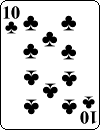
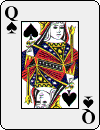
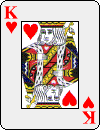
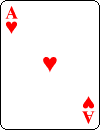
Tuesday, April 30, 2013

Never Forget a Face (Double-Dealing with a Difference)

Low-Down Triple and Quadruple Dealing Reviewed


In October 2004, in the inaugural Card ColmLow Down Triple Dealing, we presented something discovered accidentally in the spring of 2003 while living in a Madrid suburb. It concerns surprising properties of a kind of "low-down deal"--in which at least half of the cards in a packet are dealt to a pile and the rest are dropped on top--done three or four times, dealing the same number of cards each time. More recently, in February 2011's Low-Down Double Dealing With the Big Boys, we discussed something useful that can be said about only doing it twice, in the case of palindromic (i.e., symmetric) packets.

In the October 2008 print incarnation of "Low-Down Triple Dealing" from the Martin Gardner tribute book A Lifetime of Puzzles (A K Peters), we mentioned a generalization first brought to our attention about a year earlier by Martii Siren, then (and now) editor of Finnish magic magazine Jokeri. He wrote about it in that publication in March 2008. Austrian magician Werner Miller also took advantage of this observation in a trick in his 2010 manuscript Enigmaths. Our upcoming Mathematical Card Magic: Fifty-Two New Effects (A K Peters) devotes an entire chapter to this extension of Low-Down Triple Dealing, so it seems like an opportune time to introduce it here. 


Let's start with the basics of the original low-down triple dealing. Imagine a face-down packet which runs Ace-King of Hearts. Fanned face up from left to right it looks like this: 


Now fix a number between 7 and 13, perhaps 9. Hold the face-down packet in one hand, and deal 9 cards to a pile, thus reversing their order. Drop the remaining 4 cards on top. Fanned face up from left to right, we now have: 


A second application of the "deal 9, drop 4" move converts that to this:


A third application of the "deal 9, drop 4" move converts that in turn to:


The first surprise is that the original bottom card (the King) is now on the top, in fact many of the original bottom cards are now on top in reversed order. This low-down triple dealing observation is the basic for many magic effects, some of which are explored in Low Down Triple Dealing. Also discussed there, and in much greater detail in the opening chapter of Mathematical Card Magic: Fifty-Two New Effects (A K Peters), is the fact that a fourth application of the "deal 9, drop 4" move restores the packet to its original order, as is easily checked above. The only thing about 9 which makes all of the this work is that it's at least half of the packet size, 13, or, equivalently, 9 + 9 is at least 13.


Low-Down Dealing With a Difference


Let's start once more with a face-down packet which runs Ace-King of Hearts, and this time consider any two numbers s and t for which s + t is at least 13, or to put it another way, two numbers which are at least half of 13, on average. For instance, we might select 5 and 10. Focus on the 5 first: deal 5 cards to a pile, thus reversing their order, and drop the remaining 8 cards on top. Fanned face up from left to right, we now have:


Next, focus on the 10: deal 10 cards to a pile, thus reversing their order, and drop the remaining 3 cards on top. Fanned face up from left to right, we now have: 


Now we return to the 5: deal 5 cards again to a pile, thus reversing their order, and drop the remaining 8 cards on top. Fanned face up from left to right, we now have:


At this point we have done three deals (of sizes 5, 10 and 5, respectively), and 10 of the original bottom cards are now on the top, in reverse order. 

Furthermore, it's clear that one more deal of 10 cards to a pile, dropping the remaining 3 cards on top, restores the packet to its original order. All told, dealing 5, 10, 5, and 10 cards, each time dropping the rest on top, restores any packet of size 13 to its original order, just as four deals of 9 cards did. 

Try it dealing 10, 5, 10, and 5 cards, instead, i.e., using the same two numbers but switching the order, once more starting with the same packet of 13 cards as above. It works there too, and after the third deal it will be seen that the bottom 5 cards are on the top, in reverse order. Try it again, dealing 3, 11, 3, and 11 cards, or dealing 6, 9, 6, and 9 cards. 

All of the above holds more generally: starting with a packet of size n, and any two numbers s and t for which s + t is at least n, i..e., numbers which are at least half of n, on average, then if we first deal s cards, dropping the rest on top, then deal t cards, dropping the rest on top, then deal s cards again, dropping the rest on top, it turns out that the bottom card appears on the top. Moreover, a final deal of t cards, dropping the rest on top, restores the packet to its original order. The Low Down Triple Dealing discovery of a decade ago is the special case s = t

There is much to explore when s and t are different, and Chapter 5 of Mathematical Card Magic: Fifty-Two New Effects (A K Peters) is devoted to such fun. We think of the first two deals and drops, dealing s and t cards, respectively, as a kind of double-deal. We close with a spelling application which works for any 9 cards.


Never Forget a Face


Use any 9 cards from a deck. Have a spectator shuffle them and call out a number between 1 and 9 inclusive, then looking at and showing around the card in that position while you look away. Have the card replaced in that position and take the packet of nine cards, holding them under the table. Claim that you are feeling the face of the card shown around, and that your fingers never forget a face. 

Explain that you want the spectator to do a packet randomization based on the spelling of the name of the card in question, demonstrating with cards from the rest of the deck. For instance, using a packet of around 10 cards, you say, "Suppose your card is the Nine of Diamonds, then first I will spell out the word NINE, dealing one card to the table each time, and after that dropping what is left on top." Matching your words, you deal out 4 cards and drop the remaining ones on top. "We do it again for DIAMONDS." This time, deal out 8 cards and drop the remaining ones on top. Repeat, once for the value and once for the suit. Now set those cards aside, and have the spectator do it, using the nine cards from before and the value and suit of the selected card. Make sure it's done twice, and turn your head while it is done so that you have no knowledge of the number of letters used. 

Take back that packet of nine cards, and hold it under the table again. Stress that after the unknown card value and suit was used to mix the cards, twice, you obviously don't know where the selected card is. Bring the cards into view once more, and remind the audience that your fingers never forget a face: place one card face down on the table and ask what the selected card was. When the card is named, have the face-down card turned over, it should match. 

Based on the earlier discussion, in the case of Nine of Diamonds, setting s = 4 and t = 8, since 4 + 8 > 9, we know that two rounds of double-dealing and dropping as suggested, using the card value and suit for the respective deals each time, restores the packet to its original order. So if the card selected started in position 3, then it's back there after you get the cards back. However, for the shorter words corresponding to cards such as the Ace of Clubs, where s = 3 and t = 5, there are no such guarantees. Actually, these are the only values of s and t to worry about arising from card values (which have 3, 4 or 5 letters) and suits (5, 6 or 8 letters), so basically it's the just Ace, Two, Six, Ten and Clubs which need separate consideration. 

One option is simply to make sure those five cards are not among the nine which the spectator uses, but let's not take the easy way out. Imagine a face-down packet Ace-9 of Diamonds. It is readily checked that dealing 3 cards, and dropping the rest, then dealing 5 cards, and dropping the rest, all done twice to the packet, and fanning the results face up from left to right, yields: 


In other words, two application of double-dealing in this case doesn't restore the whole packet to its original order, but the cards in positions 2, 3, 4, 5, 6, 7 and 8 are certainly back where they started! So if the selected card is in any of those positions, you'll know where to find it after the double spelling of value and suit, regardles of what cards in the deck was used to determine the dealings and droppings. If the selected card is in position 1, 4 or 9--admittedly rather square choices--simply move it, under the table, to one of the other six positions, remembering which one. You retrieve it from the same position, also out of sight, after the spectator's spellings and droppings are completed. 

This effect was of course inspired by Jim Steinmeyer's landmark "Nine Card Speller" from twenty years ago (available today in his booklet Impuzzibilities (2002), as discussed in the February 2009 Card ColmEsteem Synergism. As in that trick, the card can always be located no matter what its identity, leading to the amusing possibility of a repeat performance where the spectator is encouraged to lie about the card value and suit when spelling. (Lying about the position is not an option, however.) 

There is a workaround, if desired, to avoid having to worry about the cards in positions 1, 4 or 9. First, ask for a number between 1 and 9, and reject 1 or 9 if either is suggested. Second, if 4 is called out, have the packet of 9 cards dealt to a pile, with the card in position 4 being shown around before the rest are dealt on top of it. It's now in position 6 from the top, so all is well. 

Thursday, February 28, 2013

Flushed with Embarrassment


Welcome to our second new mathemagical offering for this month. The first one, In My Heart of Hearts: Valentine's Day Special, appeared as one of the current author's Huffington Post pieces

Six months ago here, in the August 2012 Card Colm Gilbreeath Shuuffling, we considered yet another Gilbreath shuffle variation, a topic we revisit from time to time in August, e.g., see 20052006, and 2009

In November, magician John Hostler from St. Louis was kind enough to share an exciting discovery of his from last summer which he calls the Triskadequadra Principle (it's pronounced TRISK-a-de-QUA-dra). Below, we present an application of the ideas which just can't wait until next August. While John only develops the principle for four cycling suits such as CHaSeD (Clubs, Hearts, Spades, Diamonds), some version of the key ideas work for cycles of any length. We felt that suitable modifications were appropriate, and came up with an amusing multiple poker hand offering with a kicker at the end. 

Thanks to mathematician Neil Calkin of Clemson University for crucial stack refinement input in December. 

We leave it to John to explain the Triskadequadra Principle. His recent 24-page booklet The Triskadequadra Principle has all the details, along with some great applications to card magic. The nature of the results obtained bears a resemblance to those discussed in Gilbreeath Shuuffling, and the same mathematical method of analysis explains both principles. Magician and prolific author Karl Fulves had written of related explorations, under the name the "Self-Correcting Set Up" principle, for the shuffling of two packets running AceKing, in his rare magic insider book Riffle Shuffle Set Ups (originally published in 1968).

The effect below, as well as an examination of the Triskadequadra Principle for cycles of different lengths, putting it in the context of Gilbreath shuffling and known variations, is in Chapter 8 of the upcoming Mathematical Card Magic: Fifty-Two New Effects (A.K. Peters), which is due out in time for MAA MathFest in Hartford, CT.


Flushed with EmbarrassmentHow It Looks

Gather together five poker players and a poker novice. Hand the latter a packet of cards, and invite him or her to cut it several times, then split it into two and riffle shuffle those parts together, and finally to give it one more cut. 

Deal out five poker hands for the aficionados of the game, and have each person discard their worst card face down. Retain those five cards in a pile in front of you. Then each player gives his or her best card to the novice. 

You then hand over the remainder of the deck, face up, so that the five poker enthusiasts may make free choices to replenish their hands, until they each have five cards. 

The resulting poker hands are compared, and it will be seen that some players have done quite well. However, when the novice turns over the cards he or she was given, it's seen to beat the rest, having four Aces and a King. 

Just when it seems that the show is over, turn face up the discards you were given earlier. They constitute the winning hand: a straight flush.


A Little Detail

There's one little detail we didn't mention above: we're not playing with a full deck here, not at first anyway. 

Start by saying, "We'll need just enough cards for some poker hands," as you thumb off or silently count out pre-arranged cards from the top of the deck to form a pile in the other hand. The rest of the deck is set aside for now. "We should shuffle, to be fair," you continue, then address the poker novice. "Would you, please?" Hand that person the packet and have it cut a few times, then split into two roughly equal piles. Have those riffle shuffled and one more cut done. 

"You can't ask for fairer than that, can you?" you say, taking the packet back and fanning the card faces, briefly showing the audience, "Completely mixed up." 

Now deal them in a circle from left to right, one card at a time per hand, to the poker fans, until you have dealt four hands of five cards. Then look puzzled, and say, "My mistake, there are five of you, not four, sorry." Gather up the cards and deal again, this time into five hands. Comment, "It seems we don't have enough cards here, only four each. I was never very good at numbers. We'll fix that in a moment. First I want each of you to look at the cards you already have. There are probably some good ones, and some bad ones. I'll make you a deal. Get rid of your single worst card you have, just give those ones to me. Please keep all cards face down as you discard them." 

Briefly look at the five cards you are given, and comment, "Nothing too high there, oh well," and place them face down on the table in front of you. 

Address the poker novice, "Since you're new to the game, we'll give you a break. The rest of you should each donate your best card. Don't worry, you'll have a chance to replace it soon." Have those five cards set in front of the novice, also face down. 

"Since the five of you now only have two cards apiece, you may, in turn, go through the rest of the deck here, and find three cards to complement what you have so far. This isn't the way real poker works, I know, but it's fun to do once in a while. Knock yourself out!" 

This should generate a buzz of excitement. Hand the remainder of the deck, face up, to the first poker fan, on your left, and in due course to the next one, and so on, until all five of them finally have five cards. 

Recap the initial cutting and shuffling of the cards, by the novice, the discarding of low and then high cards, and the complete freedom for each person to pick three cards to add to the two received earlier. 

Ask the poker fans, "So, how did each of you fare? It's time to show all!" With any luck, there will be proud displays of full houses, flushes, straights, maybe even a four of a kind. Everyone has at least a pair. 

"Amazing, I guess it does help to have free selections for three of your five cards. Let's see how the novice did, purely by chance." The cards in front of the novice are turned over to reveal four Aces and a King. Everyone should be very impressed. 

"Incredible!" you exclaim. "You saw the cards cut, shuffled, and cut again. What are the chances that four of you still ended up with an Ace? That's what must have happened, since you each donated your best card." 

Here comes the kicker. "I'm not a poker player myself," you add casually. "It's a good thing, too. As mentioned earlier, my cards are all of low value." Turn your cards over, they turn out to be the 2, 3, 4, 5, and 6 of Clubs. "Oh dear, this is rather embarrassing. Isn't that a straight flush?" 

Your humble low-valued cards, taken together, do indeed surpass each of the other six poker hands on display. Victory is yours.


A Lot More Detail

The cards you thumb off or count out (the latter action reversing their order) at the start form a stack which you have carefully constructed in advance and planted at the top of the deck. Twenty cards are used, in four interwoven sets of five.
 
List A: 2 of Clubs, 3 of Clubs, 4 of Clubs, 5 of Clubs, 6 of Clubs. 


List B: 7 of Clubs, 7 of Spades, Queen of Clubs, Queen of Hearts, Queen of Spades. 


List C: Ace of Clubs, Ace of Hearts, Ace of Spades, Ace of Diamonds, King of Hearts. 


List D: 7 of Diamonds, 8 of Diamonds, 9 of Diamonds, 10 of Diamonds, Jack of Diamonds. 


The precise order within each list is not important. Note that the A list has the cards you want, all Clubs, with 6 being the highest value. The C list is the one destined for the poker novice, the lowest card there being a King. The other two lists consist of cards of "middling" value, between 7 and Queen; while they look tantalizing as possible poker hands, neither of them will be taken alive! 


Arrange these 20 cards cyclically as ABCDABCDABCDABCDABCD, by which we mean: start with any card from A, then any card from B, one from C, and finally one from D, then repeat in that pattern four more times. It doesn't really matter if you cut off or count out these from the deck at the outset. Also, they may be cut any number of times, for instance just before or after you hand them to the poker novice. This packet is then cut somewhere near the middle, and the two resulting piles riffled together. One more cut is given to the packet. 


When you scan the card faces, you are really looking for an appropriate place to cut, so that when you reassemble the two parts the other way, the packet is then in a highly desirable state. Simply cut it between two adjacent cards neither of which are on lists A or C. Thanks to De Morgan's law this is equivalent to the clumsier "both of which are from lists B or D (considered together)." If no such cut is possible, then no such corrective cut is necessary. 


Unsuspected by the audience, the result is five stacked quadlets (sets of four adjacent cards) with a special property, due to the Triskadequadra Principle:


Every quadlet from the top down is balanced in the following sense: it definitely contains 
one card from list A, one card from list C, and two from the other two lists, B or D.

Of course, some quadlets contain one card from each of the four lists; we call these ones perfect. The key thing is that the non-perfect quadlets contain cards from exactly three of these lists. Another consequence (not needed here) of the Triskadequadra principle is that if a quadlet has two cards from list B, then the next non-perfect quadlet will have two from list D, and this alternating pattern repeats. 

Ideally you'd like to dole these quadlets out one at a time, but that's not how poker hands are dealt, so you first deal left to right into four piles of five, then, under the pretext of having made a mistake, collect those piles in the same order and recombine. Dealing once more from left to right, this time into five piles of four, accomplishes your original goal, while seemingly following normal left-to-right dealing conventions. 


The upshot is that each of the five poker fans now has a card from the C list, which is the four Aces and one King, and, moreover, all other cards in play at this stage have lower value. More importantly, each of the poker fans also has something from the A list, and these Clubs are the lowest valued cards in hand. As a result, the A list ones will be set aside face down near you, early on, seemingly of no consequence, and then the C list cards will be donated face down to the poker novice, none of these faces being revealed until the end. 


That leaves each poker aficionado with two cards from the B and D lists. The best case scenario is that some of them have a pair of 7s or a pair of Queens. Once they are let loose with the rest of the deck, they'll have fun building what they think are strong hands, but it's all in vain. The game has been rigged so that no straight flushes are possible. You will be victorious! 


The bogus and somewhat contrived double dealing can be avoided, as John Hostler points out, by simply handing out blocks of four cards to the five poker fans after the shuffle and cut (by the novice) and your own correction cut. 


This effect can also be performed as a straight Gilbreath application. In that case, instead of merely splitting the 20-card packet before riffle shuffling, the novice deals about half of the cards to the table, thereby reversing their order. There is extra certainty about the outcome: each of the quadlets is perfect, containing one card from each of the four lists. This may allow for more fun, as there is much flexibility in how lists B and D are chosen. 


Monday, December 24, 2012

Predictability Outranks Luck

In this 12th month of '12, on the eve of the start of the 12 days of Christmas, we revisit a topic explored 12 years and 12 weeks ago, which appeared online as part of AMS's What's New in Mathematics (October 2000).

It concerns a variation of a surprising convergence result which was discovered by physicist Martin Kruskal in the 1970s, as popularized in card form by Martin Gardner. It can be found on page 274 of the latter's book Penrose Tiles to Trapdoor Ciphers (W.H. Freeman, 1989).

It's a fine example of a baffling effect in which a spectator initiates a random process, based on mentally selecting a secret number known only to him or her, yet you can almost certainly correctly predict the ultimate outcome.

Let's start by reviewing the classic incarnation. Shuffle a full deck of cards, then decide on a number k between 1 and 10. Slowly deal out the cards into a face-up pile, noting the card in position k, called the first key card, and using its value, counting out to the next key card, whose value is in turn used to count out to the following key card, and so on.

For instance, if k = 6, and the sixth card is a 9, then that's the first key card and the second key card would be the fifteenth card. Repeat as often as is possible. Here, it's conventional to agree that the royal cards (Jack, Queen and King) have a common low value, such as 5.

Eventually you arrive at a key card---perhaps the last card in the deck---from which you can't go any further, as it's not followed by enough cards to permit the next required count out. This final key card is the one to note; unless it's the final card we can think of it as a sticking point, or road block.

Of course its location depends on the particular order of the cards in the deck at the outset, and the choice of k.

What is quite unexpected is that, for a given deck order, no matter what value k has, we arrrive at the same final key card. More precisely, averaged over all possible shuffled decks, this occurs with probability about 5/6.

A proper analysis of this takes us into Markov chains and stochastic processes, but we'll provide a basic probability estimate later on, for the version we suggest, to convince you that it's not so unreasonable.

Predictable Road Block

Here's a new way to present this as a prediction effect.

Take out a deck of cards and carefully demonstrate the counting-out-the-deck principle, based on a randomly chosen number between 1 and 10 which you have an audience member call out. You can spin a yarn about the 52 cards representing a long trip, just making sure that everyone understands the importance of getting as far along the road as possible, either to the very end or until a road block impedes progress.

Now have a spectator thoroughly shuffle the deck, and then take the cards back. Rummage through them, face up, announcing that things will go much faster if only the low values are used. Pull these out as you encounter them, dropping them into a face-up pile on the table.

Hand the spectator the resulting packet of small-valued cards, now face down, and turn away. Ask for a random number between 1 and 6 inclusive to be decided on, secretly. A die could be rolled to determine this. Have the spectator use that number to initiate the process you demonstrated earlier. The spectator does this, and deals cards from the packet accordingly, until arriving at the sticking point (or the end). Have that card set off to one side face down.

Now turn back, and stare intently at the back of that card. Say, "I could be wrong, but my gut feeling is that you got as far as ....", where upon you name a specific card. Have the face-down card exposed, with any luck you nailed it.

How do you pull this off?

Before you demonstrate the counting procedure, run through the deck and dump the Jacks, Queens and Kings, adding, "to save confusion" (which is true).

Be sure to emphasize that when the spectator later deals cards to a pile, it should be done steadily so as to give no hint as to the location of any of the key cards. Say, "I'll be turned away, but I have very sensitive ears." (People do tend to deal noisily and with obvious pauses!)

Once you are convinced that the directions are well understood, have the deck shuffled once more. Take it back and say, "To speed things up, let's only use about half of the deck, say the the Aces to sixes." Now start to extract those cards openly.

Here's the secret: as you pull those twenty-four face-down cards out, dropping them one by one into a pile, you follow the same instructions that you just gave!

Choose your own secret number between 1 and 6 and then, brazenly and on-the-fly, determine your key cards in the growing pile, working from the bottom up. Yes, it requires a quick mind and steady nerves, but it's doable. The mathematics suggests that you'll probably arrive at the same sticking point or road block as the spectator will in due course, or else you'll both make it to the end. (Admittedly, it's best if the last card seen here doesn't end up being the one the spectator gets to.)

Actually, forget picking a number between 1 and 6, simply pick a very low valued card among the first few as they emerge from the shuffled deck, say a 2 in the third position from the bottom of the pile you build up, and go from there. Of course, the spectator will probably start from a different card, once you have handed over the 24-card packet face down, but you'll quite likely reach the same destination.


For instance, imagine that the twenty-four cards in the packet are in the order displayed above, read row by row from left to right. Try using any of the first six cards as the starting point. If the Ace of Hearts is used, then the next image shows the resulting key cards highlighted relative to the rest. Evidently, the road block is the 5 of Diamonds.


As mentioned above, we recommend making your choice small in value and early in the packet: if possible, favor an early Ace or 3 over a 4 or higher in position four or five or six.

As it happens, with the arrangement considered above, all choices of starting point lead to the 5 of Diamonds. It's the common sticking point.

In general, you and the spectator float merrily downstream, in different time frames, probably from different starting points, certainly oblivious to each other's progress. Yet, you can be quietly confident that you're on tributaries of the same river with one ultimate destination.

Our third picture highlight all possible key cards for various starting cards. More than half of the packet doesn't even get a look in.


Of course, had the original array been as above but with the 5 and 4 of Diamonds switched, then all roads would have lead to the very end.

Why does it work?

Here is a heuristic argument----modified from one suggested by Tony Phillips of SUNY, Stony Brook, for a full deck---which sheds some light on the phenomenon.

There is a 1/6 chance of you picking the same first card as the spectator.

On average, that first card has value (1 + 2 + . . . + 6)/6 = 21/6 = 7/2.

That's also the average length of subsequent steps, so the density of the spectator's key cards can be expected to be 2/7.

Similarly, you yourself should encounter about 6 key cards on average after the first, since (24 - 3.5)/3.5 = 5.86. Each of these has a 2/7 chance of being one of the spectator's key cards, and hence a 5/7 chance of missing.

The probability of you {\em not} hitting one of the spectator's key cards on the first or any later chance is therefore (5/6) x (5/7)6 = 0.11.

So, the probability of a win for you, by this rough estimate, is about 89%, which is not shabby.

A full mathematical treatment of these ideas can be found in the paper "On Kruskal's Principle" by Wayne Haga & Sinai Robins, who also provide a great online simulation.

One presentational option is to write down an actual prediction, which is left to one side, right before you hand the spectator the packet of 24 cards to deal. At the end, you can then turn back and say, "Earlier I wrote down the card I thought you'd get to." The spectator's card is now turned face up, and is found to match your written prediction.

Magician Gordon Bean, in his article "A Labyrinth in a Labyrinth" from Puzzlers' Tribute (AK Peters, 2002), suggests spelling out one card for the each letter in the name of the value of key cards, so that, for instance, "ten" advances only three cards (T-E-N). This greatly increases the likelihood of reaching the same sticking point. A word of caution, however: spelling values on this scale is risky, as it's so easy for one or both of you to get confused and revert to ordinary counting.

Run through a full demonstration of whichever counting procedure you adopt, pausing at each key card for clarity, before you let the spectator loose with the cards. It takes patience and care on the part of two people for this to work out.

The Final Word(s)

Linguistic applications of the Kruskal count principle, leading to a final key word in a piece of text, are entertaining in their own right, and were much loved by Martin Gardner. Author John Allen Paulos, winner of 2013 Joint Policy Board for Mathematics (JPBM) Communications Award, has a nice treatment of a Kruskal-inspired biblical hoax in his book Once Upon a Number--The Hidden Mathematical Logic of Stories (Basic Books, 1998). The excerpt in question is freely available online.

(On an tangentially related note, readers may be interested in a miracle of bibilical proportions—related to card magic—which we recently wrote about elsewhere.)

Finally, a word about Persi Diaconis & Ron Graham, whose wonderful writing on de Bruijn sequence card magic we've referenced here in December 2008, and December 2011. Their beautiful and inspirational book Magical Mathematics: The Mathematical Ideas that Animate Great Magic Tricks (Princeton University Press, 2011) is winner of the 2013 Euler Book Prize.

'Tis a season of celebration!

Curiously, "Outranks Luck" is an anagram of "Kruskal Count." 

Wednesday, October 31, 2012

All or Nothing Trickle Treat

Just in time for election season, we present a ternary trickle down principle. First, we note that Martin Gardner (1914-2010), the best friend mathematics ever had, would have turned 98 on 21 October. There is a Twitter feed in his honor at WWMGT, for which suggested contributions (What Would Martin Gardner Tweet?) are welcome. 

In the USA, Gardner did for recreational mathematics what Julia Child did for recreational cooking. His influence spread much further afield actually, and like Child, he also inspired quite a few professionals along the way: mathematician and card expert Persi Diaconis has correctly noted, "he has turned thousands of children into mathematicians," playfully adding, "and thousands of mathematicians into children." After the above culinary comparison was made, author and Gardner friend Chris Morgan commented, "I was lucky to have spent time with Julia in the 1980s (I took three cooking classes with her in Boston). She was very much like Martin in many ways." 

Last October here, we made available here numerous card classics that Martin had published in his legendary "Mathematical Games" columns in Scientific American, following up on the earlier June 2010 and August 2010 Card Colms. 

October is now well established worldwide as the anchor month for annual Celebration of Mind events, which promote Martin's wide interests and remarkable and extensive written legacy. These gatherings bring together young and old, trained and untrained, to have fun with logic, puzzles, magic, optical illusions and more, very much in the spirit of the ever-curious Gardner. 

This year, in addition to seventy plus Celebration of Mind events listed at the event map here, there are an equal number of Flexagon Parties going on all over the globe, inspired by Vi Hart's viral videos on YouTube (don't miss the fourth food themed one, which would have delighted both Child and Gardner). Vi was of course inspired by the Hexaflexagons article which marked the start of Gardner's quarter century tenure atScientific American

Incidentally, it's not too late to host or attend events of either type. For instance, this year's MAA Celebration of Mind event is set for 5th December. Please consider joining or hosting an event, formal or informal, wherever you are. 

October is also when the world's most extensive and successful mathematics outreach programme Maths Week Ireland is held. This year, over a nine day period ending on Martin's birthday, it exposed over 150,000 people of various ages in both the Republic of Ireland and Northern Ireland to the joys of mathematics and logical thinking, with several nods to Gardner thrown in for good measure. The closing event was really a Celebration of Mind show and tell for the whole family, facilitated by a dozen presenters, which over a thousand people attended. I had the pleasure of participating, sometimes alongside notable Gathering for Gardner regulars such as Fernando Blasco. Top notch speakers included Colin Wright and David Singmaster. 

It was while driving towards Sligo a fortnight ago with Maths Week Ireland mainstay Dr. Maths, on the way to address hundreds of school children, that I was introduced to a delightful recreation with triangles which forms the basis for this month's offering here. Like the title below, it's hard to resist, and I'm confident that Martin would have found it fascinating.


Humble Contribution

Start with a row of n items randomly selected from three possible types, say red, blue and white poker chips. Underneath each pair in the row, place a third item to form triangles, according to this rule: 


If the two vertices above are the same colour, then the third one matches both, whereas if the two vertices above are different colours, then the third one is different from either. 

In other words, in each such downward-pointing tiny triangle, one never has only two vertices matching. When it comes to vertex matching, it's an all or nothing situation. 

Once the initial row of n items is processed to yield a second row of n - 1 items below it, process that row in the same way, to get a third row of n - 2 items underneath it. Continue, eventually getting a single item at the very bottom of an n-row triangle. 

Here are three examples with poker chips: 


Note that in each three-chip downward-pointing trianglebut not necessarily in their upward-pointing cousinsany two vertices determine the third according to the All or Nothing rule. Hence, upon reflection, or should we say upon rotation, any completed triangle (of any size) may be turned 120 degrees in either direction to yield an equally valid arrangement. Indeed, the second and third images above are exactly such rotations of the first one! 

Here is the main question we wish to ponder: 


Given the top row of such a triangle, of any size, can one easily predict what the final bottom vertex will be?

Note the pleasing random-seeming arrangements of "solid sub-triangles" of various sizes in red, blue and white, which make up the larger triangles above. It almost suggests a fractal behaviour. 

This can all be implemented with cards, for instance, using only three suits (which coincidentally was considered in the last Card Colm). 

Alternatively, we could use face-up red and black and face-down cards for the three types, as illustrated below. 


The secret here is to focus on the fourth row from the bottom: specifically its starting and finishing items. Those two cards alone determine the final bottom card according to the All or Nothing rule! No matter what other two cards are between the face-down blue-backed card and the 7 of Hearts, the final card will always be Black. In fact for every downward pointing "four triangle," consisting of ten cards, any two of the three vertex cards determine the third according to the same rule. 

What's so special about four? Here's a hint: it's also true for downward pointing "ten triangles" consisting of 45 cards headed by a row of ten cards. Here's a perfectly reasonable question to also ponder: what is the next number after ten which also works? (You'll need eight decks of cards.) 

Now suppose the following five cards are laid out, and our goal it to speedily guess the nature of the last card if the associated fifteen card triangle is completed. 


It's easy to see that the first card in the next row should be Black. Likewise the last card in this row should be Black, so the final card of the completed triangle should also be Black. 

A similar "trickle down" approach can be used to predict the nature of the final card starting with rows of length six or seven. For longer rows, it may be easier to go the other direction, noting that, 

Given a triangle of any size, it can be extended upwards in exactly 3 distinct ways, by first deciding on the nature of any single card in the row above, and then filling in the rest to be consistent with the All or Nothing rule. Just be sure to always "trickle down" (not up)!

It's not hard to do this for a row of nine cards, extending it mentally to a row of ten and then quickly deducing the nature of the final card at the bottom if eight more rows were constructed. 

The principle underlying the above observations may be found in the upcoming paper "Triangle Mysteries" by Erhard Behrends & Steve Humble, which is due to appear in The Mathematical Intelligencer in June 2013. There, the result hinted at above is generalized, and the connection with Pascal's triangle is explored in depth. Thanks to Steve (Dr. Maths) for the preview! 

Note that from a large downward-pointing trianglewhich is as we noted completely determined by any of its three sidesone can also carve out Halloween hexagons with interesting properties. Have fun! 

Friday, August 31, 2012

Gilbreeath Shuuffling

For many years I drove a car whose audio system had a "source" setting which offered a choice of C (for CD), R (radio) and A (auxiliary, which turned out to work with an mp3 player), only accessible via a one-way loop button. Toggling (troggling?) between them seeking the desired option, while keeping one eye on the road, was not ideal. I could never remember what order they cycled through, until one day it dawned on me that there were only two possibilities, and I also noticed that the manufacturers had thoughtfully arranged them as C-A-R over and over. From then on, I could change the source quickly and accurately while driving without risking life and limb by looking down. 

This real life manifestation of the fact that (up to rotation) there are (n-1)! ways to arrange n things in a circle came to mind when analyzing "ESP + Math" from page 48 of More Self-Working Card Tricks by Karl Fulves (Dover, 1984), which we present below in slightly modified form. That tome is one of four from the same author and publisher which are devoted to card tricks many of which have mathematical underpinnings. 

Fulves has the reader assemble two packets of 12 cards side by side and then riffle shuffle them together. From the top down, the first packet consists of four rounds of Spades, Hearts, Diamonds in that order (any values). The second packet consists of four rounds of Spades, Diamonds, Hearts, in that order (any values). No Clubs are used, and the card values play no role. 

Suppose, for instance, that the first packet is set up as: K♠, 5♥, 9♦, 8♠, J♥, 3♦, 5♠, 8♥, 7♦, A♠, A♥, 5♦, and the second packets is set up as: 3♠, 10♦, Q♥, 7♠, 4♦, 10♥, 9♠, K♦, 6♥, 2♠, 2♦, 7♥. When riffle shuffled, the reader ends up with a packet of 24 cards. The display below shows one possibility from top to bottom, considering the second row of 12 as following on from the first: 
 

Click to enlarge

If cards are now peeled off three at a time from the resulting face-down packet, then a curious pattern emerges. Of course, in the above example, the shuffling can't have been very even, as the first five cards displayed clearly came as a clump from one of the initial packets of 12 cards. Hence, the first three cards feature one of each suit. 

Consider the next three cards: there are two Spades, and one of them is the first card of this triple. There is no Diamond. The next three cards contain two Diamonds, one of them in the first position, and there is no Heart. The fourth group of three cards contains one of each suit, so ignore it. The next group of three, which starts the second line in our display, contains two Hearts, one in the first position, but no Diamond is present. In fact, no matter how the riffle shuffle turns out, a general prediction principle applies: 

Ignoring consecutive triples in which each of Diamonds, Hearts and Spades are present,
there is a cascading sequence of deductions that can be made: the first triple with a suit
repeated features two Spades, and one of them is the first card in that triple. Whichever
suit is not represented appears twice in the next triple with a suit repeated, and one of them
is the first card in that triple. This logic repeats as long as triples with repeated suits show up.

Note that above we are referring to just the eight consecutive triples which arise starting with the first card, not to "running triples." The claims made also hold for any two packets whose sizes are multiples of three, with suit cycling as described. 

Why does this work? Before answering, we present a variation which might engage audiences more. It also aims to reduce the likelihood of getting any triples in which all three suits are present. 

We then look at the mathematics behind it, and extend from cycles of length three to cycles of length four (or more). It turns out that the case of cycles of length two---which doesn't lead to an interesting effect in our context---derives from the original Gilbreath principle of 1958 Hence, in essence, what we have here is a generalization of that principle. It's related to, but distinct from, the broader Gilbreath principle from 1966.


Guessing Game

First, let's agree to mix the cards a little differently, using Lennart Green's rosette shuffle. Combinatorially, it's equivalent to the riffle shuffle suggested above: the cards within each packet of 12 remain in their original order when considered within the final packet of size 24. 

Here's how to do this. With the two packets side by side, use the fingers to "twirl" the left one into a rosette, repeating for the right one, and then push the rosettes together. The images show the sequence of moves. Finally, square up the resulting packet. 

Click to enlarge.
Applying this to the two original packets of 12 cards above, and taking care to ensure that the top cards of each packet end up together, we may end up this packet of 24 cards: 
Click to enlarge.

As is easily verified, the prediction principle does not let us down, although once again two of the eight triples contain cards of all three suits. (We have found through experimentation that the rosette shuffle very often results in fewer than two such triples.) 

Here's a way to take advantage of this principle. Deal the packet of 24 shuffled cards into three piles from left to right. Retain the first one for yourself, and give the others to two spectators. Request that each person deal into a pile on the table to verify that they have eight cards, while doing likewise yourself; this is actually a ruse to reverse the order of each pile. 

Next, suggest that a guessing game be played. Have each spectator guess the suit of the top card in their respective piles, before turning them over. You already know that one of them is a Spade, so that if the first person's card turns out to be something different, you can even guess that the next person's is a Spade. In any case, you end up by correctly guessing that yours is a Spade before you turn it over to confirm. Chances are, you'll do much better than the spectators who have absolutely nothing to go on, and don't even realize that there are no Clubs in play! Have those three cards set aside face down, quietly noting which suit you did not just see, and proceed to the guessing and uncovering of the suits of the next three exposed face-down cards. After a few successful rounds say, "Perhaps you think I need to see your card faces to guess mine correctly? This time let's all guess before anyone exposes their cards!" You still come out ahead most of the time, despite the misdirection of the words you just uttered. In the hopefully rare cases where all three cards are of different suits, so that your reasonable guesses are wrong, modestly say, "Nobody's perfect all the time." 

Given the visibly shuffled state of the cards, your audience should be baffled (and impressed) by your near-perfect predictive powers.


Mathematical Games

So what is the mathematics behind all of this? Let Spades, Hearts and Diamonds be represented by 0, 1, 2, respectively, so that the packet of the left, from top to bottom, is 012012012012, and the packet on the right is 021021021021. Here's the key observation: 
The effect of riffle (or rosette) shuffling these two and then pulling off three cards at a time, is to, (A) line up the left packet in reverse beside the right one to get 210210210210 021021021021, and (B) successively extract three adjacent cards "from the middle", starting by including at least one of the two initially adjacent 0s. Ignoring the undesirable cases where all three cards come from one of the packets, we therefore get as our first triple either two 0s and a 1, with a 0 on top, or two 0s and a 2, with a 0 on top.


In the first case, the next triple---again assuming it involves cards from both packets---will be extracted from the middle of 2102102102 21021021021, and hence consist of two 2s (and a either a 0 or a 1). In the second case, the next triple will be extracted from the middle of 21021021021 1021021021, and hence consist of two 1s (and a either a 2 or a 0). Now the pattern which gives rise to the claimed prediction principle should be clear.


Mega Guessing

For a version with groups of four cards each time, arrange two packets of say 16 cards, one cycling Spades, Hearts, Clubs, Diamonds, from the top down, and the other cycling Spades, Diamonds, Clubs, Hearts. 

Mathematically, from top to bottom, we have 0123012301230123 on the left, and 0321032103210321 on the right (the suit/numerical correspondence has changed from what we had above). This time, we can assert: 

The effect of riffle (or rosette) shuffling these two and then pulling off four cards at a time, is to, (A) line up the left packet in reverse beside the right one to get 3210321032103210 0321032103210321, and (B) successively extract four adjacent cards "from the middle", starting by including at least one of the two initially adjacent 0s. Ignoring the undesirable cases where all four cards come from one of the packets, we therefore get as our first groups of four cards either two 0s, a 2 and a 1, or two 0s, a 1 and a 3, or two 0s, a 3 and a 2. In all three cases there is a 0 on top, and the next (worthy!) group of four contains two cards of the suit not represented in the previous group of four.

The same kind of effect as before can be pulled off here: have the 32 cards dealt into four piles of four, then re-dealt to reverse the card order. Now, if you claim the first such pile for yourself, you can correctly predict the suit of most of the those cards provided that you progressively get to see the corresponding cards in the other three piles. The guessing game is a good and distracting way to achieve this. 

The principle extends to five or indeed any larger number. Readers may like to try out a version with cycles of length 13.


Clopening Remarks

Question 1: Is it mandatory to reverse the order of each pile? What if one were to work up from the bottom of the original packets instead of down from the top, perhaps modifying the packet set-up accordingly? 

Question 2: Is a there way to take advantage of the card values as well as suits, to improve the accuracy of the predictions made? 

Question 3: Are there other such variations on the Gilbreath principle, for cycles of length four or more, of interest? Perhaps shuffling a packet cycling Spades, Hearts, Clubs, Diamonds, from the top down, with one cycling in some order not considered above (or below)? 

Question 4: Have we really exhausted the possibilities for cycles of length three, notwithstanding our starting C-A-R comments? After all, there are other arrangements of the two starting packets relative to each other! One of them fits in with the Bligreath Principle discussed here in August 2009. 

We finish by pointing out a connection between what we have considered and the general Gilbreath shuffle principle. Let's first review the latter, via a standard effect which is to stack a deck with the suits cycling in some fixed order, then deal out about half of the cards to form a pile, before riffle shuffling those into the remainder. Pulling off four at a time, one is guaranteed to have all four suits represented each time, though in what order is anyone's guess. 

Mathematically, that's equivalent to starting with something like 301230123...0123 in one pile (those cards retained in the hand) and 2103210...3210 in another on the table. The effect of riffle (or rosette) shuffling these two together and then pulling off four cards at a time is to reverse one of those piles and place it beside the other yielding 3210...321032103 2103210...3210, and then extract four cards at a time, starting "in the middle" with either the 3 or 2 (or both) which abut the visible gap above, along with several adjacent cards. Each time one must get one of each of the four types. 

A similar connection exists between the "ESP + Math" effect and the Gilbreath principle for packets consisting of repeated cycles of length three. 

When all is said and done, what we have explored above is the case of inserting one additional "repeated" card near the middle, beside one of the same type, in the usual Gilbreath context, and then proceeded to riffle or rosette shuffle. While it changes the nature of one's prediction, predict one certainly can; at least for a quarter (or a third) of the shuffled cards, modulo those annoying cases where all types are represented in the groups pulled off. 

Instead of starting with the effect in the Fulves book and extending it from cycles of three cards to cycles of four cards, what happens if we consider cycles of two cards? It turns out that we are basically revisiting familiar Gilbreath terrain. Without loss of generality, we are riffle (or rosette) shuffling together two packets of the same type, each cycling Black Red over and over from the top down. The effect is predictable and well-known (and is covered in the Fulves volume referenced above), as it's just a basic "out of synch" Gilbreath shuffle of the type first published in 1958. It is customary to "restore" such shuffled packets to the usual post-Gilbreath state by splitting between two cards of like colour, after which each pair pulled off definitely consists of one Black and one Red card, in some order. However, if this step is skipped, then each pair which doesn't consist of one card of each colour instead consists of two of the same colour, starting with two Blacks, then two Reds, etc. This is no great surprise, and is hard to make into an engaging effect; for one thing, Black/Red or Black/Red pairs occur here with great frequency. (The only interesting part is the alternation of the colours when two like-cards are paired up. Of course one will never encounter more than two adjacent cards of the same colour; something which characterizes a packet in post-Gilbreath mode.) 

In conclusion, inspired by "ESP + Math" from the 1984 Fulves volume, we have suggested a generalization of the binary (k = 2) Gilbreath principle published in 1958. It's different in spirit from the more general (arbitrary k) Gilbreath principle published in 1966, though it's closely related to it. 

Many other shuffle variations may be found (so to speak) in the hard to find book Riffle Shuffle Set-ups, also by Karl Fulves (1968). 

The positioning of repeated cards near the middle of the shuffled packets above prompted our tongue-in-cheek title, Gilbreeath Shuuffling, which we recommend be pronounced gil-BREEATH SHOE-fling to distinguish it from the more normal GILL-br'th shuff-l'ng. 

Thursday, June 28, 2012

Something Old, Something True, Something Borrowed, Something New


Something Old

There's an old scam in which a victim is offered a free choice of any five of ten face-down cards, to serve as a poker hand, the other five being retained by the person offering the cards. When the resulting poker hands are compared, it turns out that the victim has the losing hand. 

This can be repeated as often as is wished. This principle, often referred to as the "Ten Card Poker Deal," goes back at least as far as Card Control (2nd ed., 1947) by Arthur Buckley. 

Another version sees the victim being permitted to win a few times at first, in order to instill a false sense of confidence, perhaps before the game is played for money. Then, the winds of fortune mysteriously change. 

For one performance only, the cards could be offered openly, face up, one at a time. A high-valued card such as Ace is an early contender for attention, it being assumed that the victim won't be able to resist its fatal charms. 

The secret is very simple. As hinted at above, there is a single dud among the ten cards---in isolation it may appear to be valuable---such that whoever gets it loses without a doubt. The other nine cards are carefully planned in advance of course, but the person offering the card choices just has to make sure that the victim gets stuck with the dud. 

We've been deliberately vague about how the cards are offered to the victim and then selected; various methods can be used. Perhaps the dud's back is subtly marked, so that it can easily be tracked, and steps are taken to unload it ASAP. 

Such not-so-honest approaches are far from the spirit of mathemagical effects, so in what follows we instead offer three ingenious and fair-seeming ways to arrive at the desired card distribution. These methods have been explored in previous Card Colms, and can be used here to control who wins on each round. 

The required ten cards are: three sets of three of a kind, for instance three 3s, three 8s, and three Kings, together with the dud, which is any non-matching card---below we'll settle for a Jack---which is known as the Jonah card. Whoever gets the Jonah card loses, without fail. 

The suits here can be arbitrary; for that matter the relative values play no role either, as they are never compared.


Something True

Before we show why success or failure here always boils down to control of the Jonah card, we need to be clear as to the ranking of the various possible poker hands, i.e., selections of five cards from a standard deck. 

There are 52!/(5!47!), or roughly 2.6 million such selections, which is so many that even if you were to play enough poker in your life to encounter 100,000 hands, you'd still only have seen less than 5% of them. 

The relative scarcity (and hence value) of some of the commonly desired Poker hands is reflected in this chain, starting with the rarer hands: 


Royal flush > straight flush > four of a kind> full house >
flush> straight > three of a kind > two pairs > one pair.


The rankings are transitive, so that for instance, a flush beats two pairs, but four of a kind beats both. 

Returning to the Jonah card issues, let's suppose that the cards in question are: 3♣, 3♠, 3♦, 8♥, 8♣, 8♦, K♥, K♠, K♦ and J♠. 

First focus on the hand with the Jonah card; it's not difficult to see that one of the following three cases must hold. 

Case 1: This hand also contains three of a kind, and one other card, as shown in the top row here. The bottom row is the other hand. 


Figure 1: Typical losing and winning hands in Case 1


Then the other hand wins, being a full house containing three of a kind and a matching pair. There are 54,912 five-card hands with just three of a kind, compared to only 3744 full houses. The hands are something like what is shown above. 

Case 2: The hand with the Jonah card also contains two pairs, as shown in the top row here. The bottom row is the other hand. 


Figure 2: Typical losing and winning hands in Case 2


Then the other hand still wins, containing three of a kind and two unmatched cards. There are 123,552 hands with two pairs, compared to only 54912 hands with just three of a kind. The hands look something like what is shown above. 

Case 3: The hand with the Jonah card also contains one pair and two non-matching cards, as shown in the top row here. The bottom row is the other hand. 


Figure 3: Typical losing and winning hands in Case 3


Then the other hand wins one more time, as it contains two pairs. There are 1,098,240 hands with just one pair, compared to 123,552 hands with two pairs. The two hands look something like those above. 

In conclusion: the trick, so to speak, is to control who gets the Jonah card.

Something Borrowed

Here are three clever ways to control who gets the Jonah card, while appearing to randomise how the cards are distributed.
  1. In the April 2006 Card Colm, we explained Bill Simon's 64 Principle in general, and two months later applied it to the control of ten cards for two poker hands in Better Poker Hands Guaranteed, specifically in "Better Poker Hands with Bill Simon." The probabilistic considerations there can be ignored however; we know what we're dealing with here, and there's only one card to control.
  2. It was also in the June 2006 Card Colm, that we introduced a Position Parity method of controlling card distribution for two poker hands, in "Martin Gardner's Coins to Cards Effect," and "Better Poker Hands with Martin Gardner."
  3. In the October 2008 Card Colm, we explored the Monge Shuffle, which is an in-hand way to mix cards.

    As seen in "Better Poker Hands With Gaspard Monge" there, it's especially interesting for a packet of ten cards, because the cards in positions two, five and eight just keep cycling around, and the one in position four doesn't move at all. So the ten cards can be subjected to as many Monges as the victim asks for, and assuming the Jonah card started in one of the four key positions just mentioned, it's still in one of those slots. The losing hand can be teased out using a spelling routine as suggested in that 2008 column, but a much easier option is available.
Something New
  1. When using Bill Simon's 64 Principle, simply start with the Jonah card in any of positions three to six from the top of the packet of ten cards. Plenty of innocent-looking in-hand shuffling can be done which preserves that key fact, before launching into the "free-choice" phase.
  2. To implement the Position Parity method, pay attention to which end of the row of ten the selections start from, and who picks first. That way, you control everything just by knowing if the Jonah card starts in an even- or odd-numbered position. Additional shuffling of various types can be done which won't change the outcome, for instance, experiment with running off---into a waiting hand---either an even or odd number of cards, and putting them back at the face or behind the remainder. (Start with alternating Black and Red cards to get a feel for the possibilities.)
  3. It's easiest of all to Monge Shuffle repeatedly: arrange it so that the Jonah card is in the position four at the outset. It stays there throughout any number of Monges, so that when the victim is satisfied that the cards are mixed, you can either say, "You take the top five, I'll take the rest, let's see how we did," or deal into two piles, alternating, making sure the victim gets the second one. You could even add more layer of deception in the dealing situation; asking for one of the piles to be indicated, saying, ``You want me to have that pile? Fine," if it's the first one, and "That's the pile you want? Okay," if it's the second one.